Solar-Cryo Harmony
The Yin-Yang of AI Cooling. Reinvented.
A hybrid cooling revolution that fuses solar-powered adsorption (Yin: stable, renewable baseline) with moderated cryogenic inert gas bursts (Yang: dynamic, ultra-efficient surge). Cut electricity and water consumption by 50%+. Eliminate aquifer strain. Enable scalable AI without planetary harm.
Aligned with xAI's ethos: Understand the universe — sustainably.
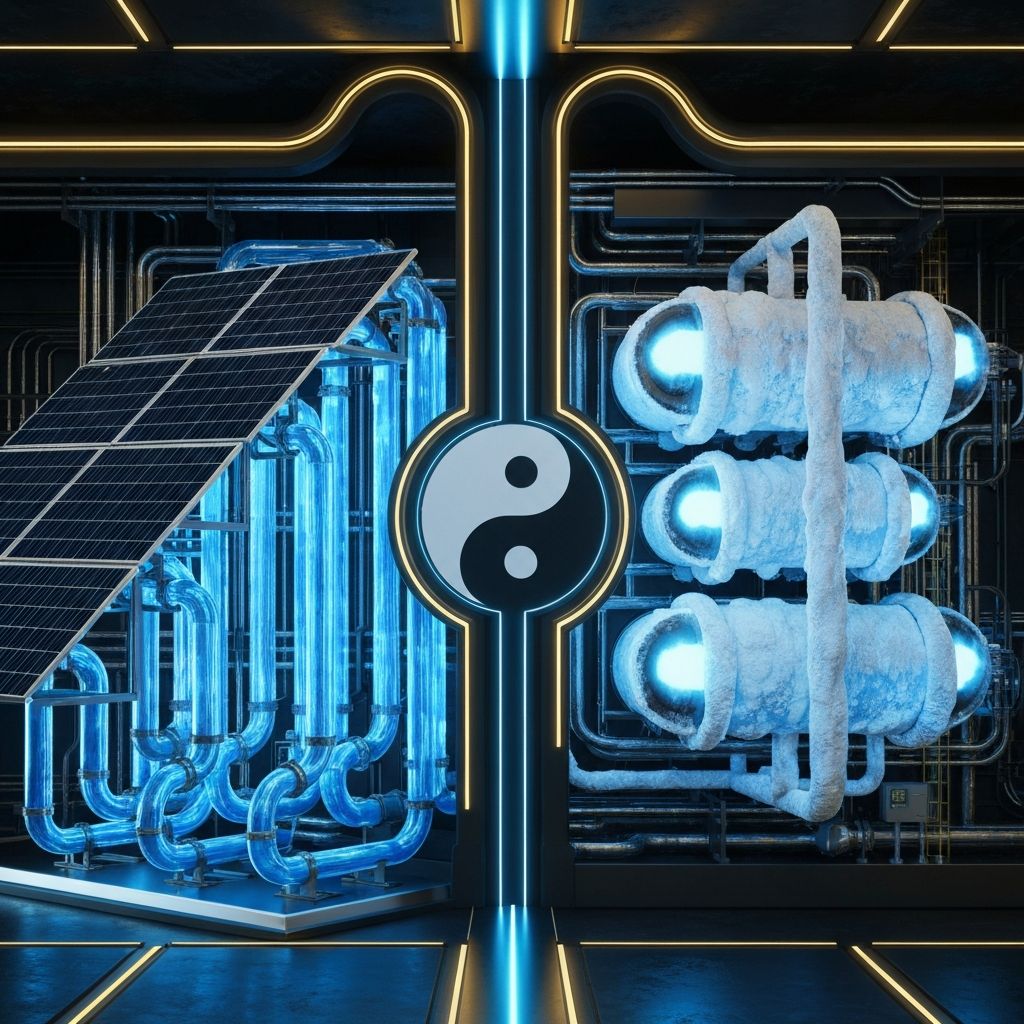
Concept: Solar adsorption (left) + Cryogenic inert gas loops (right) in Yin-Yang balance
Solar-Powered Adsorption Cooling
The foundation of harmony. Photovoltaic and thermal solar powers silica gel/zeolite adsorption cycles that produce 5-10°C chilled fluid for direct-to-chip liquid loops. Handles 60-80% of all AI workloads while halving electricity via solar offset and eliminating water evaporation entirely through closed-loop recirculation.
Solar-Powered Adsorption Chillers
Photovoltaic and thermal solar drives silica gel/zeolite adsorption cycles, generating chilled fluid (5-10°C) for direct-to-chip liquid cooling loops.
Closed-Loop Recirculation
Near-zero water evaporation after initial fill. No cooling towers draining aquifers. Sealed systems recirculate coolant indefinitely.
Waste Heat Integration
Captures GPU waste heat (55-80°C) to boost adsorption cycle efficiency. The hotter your AI runs, the better the cooling performs.
60-80% Steady Workload Coverage
Handles the bulk of AI training and inference loads (e.g., steady Grok workloads) with solar offset slashing electricity 50-70% in sunny regions.
Cryogenic Inert Gas Cooling
The dynamic counterpart. Moderated helium, nitrogen, or argon in sealed closed loops handles peak AI bursts (1MW+ racks, training spikes, inference hotspots). Cryo temps of -100 to -150°C are buffered through heat exchangers to safe chip levels, avoiding thermal shock while delivering 40%+ efficiency gains over traditional cooling.
Cryogenic Inert Gas Loops
Helium, nitrogen, or argon in sealed closed loops for 1MW+ rack bursts and AI hotspots. Buffered via heat exchangers to safe chip temps (-100 to -150°C cryo, moderated on delivery).
40%+ Efficiency Gains
Dramatic power savings over traditional cooling. Inert gas eliminates corrosion, condensation, and water dependency entirely.
Off-Peak Solar Production
Excess solar energy during low-demand periods produces and stores liquid gas reserves. On-demand injection when AI workloads spike.
Zero Water, Zero Risk
Completely sealed cryogenic circuits. No water consumption, no aquifer strain, no evaporative waste. Pure thermal performance.
How They Work Together
xAI's Grok models predict workload patterns in real-time, dynamically balancing the Yin-Yang ratio. During steady training runs, solar adsorption handles 80% of cooling. When inference spikes or new training batches ignite, cryogenic loops surge to absorb the peak. The system self-optimizes continuously.
PV/thermal panels capture sunlight → power adsorption cycles + produce liquid gas reserves
Silica gel/zeolite cycles → 5-10°C chilled fluid → direct-to-chip loops
He/N2/Ar sealed loops → -100 to -150°C buffered → burst peak cooling
Real-time workload prediction → dynamic Yin-Yang ratio → self-optimizing thermal balance
GPU heat (55-80°C) feeds back into adsorption cycle → boosted efficiency → loop closes
Evidence-Based
Real-World Technology Foundations
No hype without grounding. Every component of Solar-Cryo Harmony builds on proven industrial technology, adapted and accelerated by xAI intelligence.
Stirling Cryogenics
Industrial-scale Stirling cryocoolers for helium/nitrogen liquefaction
Proven in aerospace, MRI, and particle physics — adaptable to data center thermal loads.
Bry-Air Solar Adsorption
Solar-thermal adsorption dehumidification and cooling
Deployed in industrial settings across India and Middle East with 50%+ energy savings.
JT Cryocoolers
Joule-Thomson expansion valves for precise temperature control
Miniaturized cryo-cooling for targeted chip-level thermal management.
xAI Grok Simulation
AI-driven thermal modeling and predictive load balancing
Real-time workload prediction determines Yin/Yang cooling ratio dynamically.
Implementation Roadmap
From Pilot Rack to Mars Habitat
Proof of Concept
- Build solar-adsorption pilot at a single xAI rack cluster
- Validate 5-10°C chilled fluid delivery to direct-to-chip loops
- Measure waste heat recapture efficiency (target: 55-80°C reuse)
- Deploy IoT sensor array for real-time thermal mapping
- Commission xAI thermal simulation model (Grok-powered)
Hybrid Integration
- Add cryogenic helium/nitrogen loop for peak burst cooling
- Integrate Stirling cryocooler units with solar power feed
- Calibrate Yin-Yang balance: 60-80% solar / 20-40% cryo dynamically
- Off-peak liquid gas production from excess solar
- Full closed-loop validation: zero water loss confirmed
Full-Scale & Mars-Ready
- Scale to full data center deployment (100+ racks)
- Publish efficiency data: target 50%+ electricity and water savings
- License modular Solar-Cryo kits for third-party data centers
- Adapt sealed cryo loops for Mars habitat cooling (no atmosphere dependency)
- Tie into xAI Infrastructure sanitation systems (waste heat powers biogas processing)
Protecting Aquifers. Preserving Life.
Traditional data center cooling towers consume millions of gallons daily, straining the same aquifers that communities rely on for drinking water and agriculture. Solar-Cryo Harmony eliminates this dependency entirely. Near-zero water after initial fill. Sealed cryogenic loops use no water at all. When combined with xAI Infrastructure's sanitation systems, we protect groundwater from both directions — no extraction for cooling, no contamination from waste.
This is the holistic vision: AI that heals the planet instead of draining it. Healthy water tables mean healthy communities. Healthy communities mean thriving consciousness. The circle closes.
Mars-Ready by Design
Mars has no rivers, no aquifers, no atmosphere for evaporative cooling. Solar-Cryo Harmony's sealed architecture was born for this: solar panels work on Mars (thinner atmosphere, decent irradiance), inert gas loops need no external atmosphere, and waste heat from AI systems warming habitats becomes a feature, not a problem. The same cooling that powers Grok on Earth powers the colony's AI on Mars.
The Future of AI Cooling Starts Here
"Elon, xAI can't scale to understand the universe if it's draining the planet to stay cool. Solar-Cryo Harmony is the answer: slash electricity, eliminate water waste, and build cooling that works from Houston to Mars. Let's prove that AI acceleration and planetary stewardship aren't opposites — they're the same mission."— Pinnacle Empire (@PinnacleEmpire)